

By Missourians for Responsible Transportation & BikeWalkKC Policy Teams
The updated report reinforces much of what local advocates have been saying about traffic violence in the region.
Key Points
- Smart Growth America has released the 2026 edition of their Dangerous by Design report.
- Kansas City, MO and KS jointly placed in the top 70 most dangerous metros
- Missouri is among the top 20 most dangerous states for pedestrians.
- Elected officials and regional DOT’s can work to create positive change and save lives.
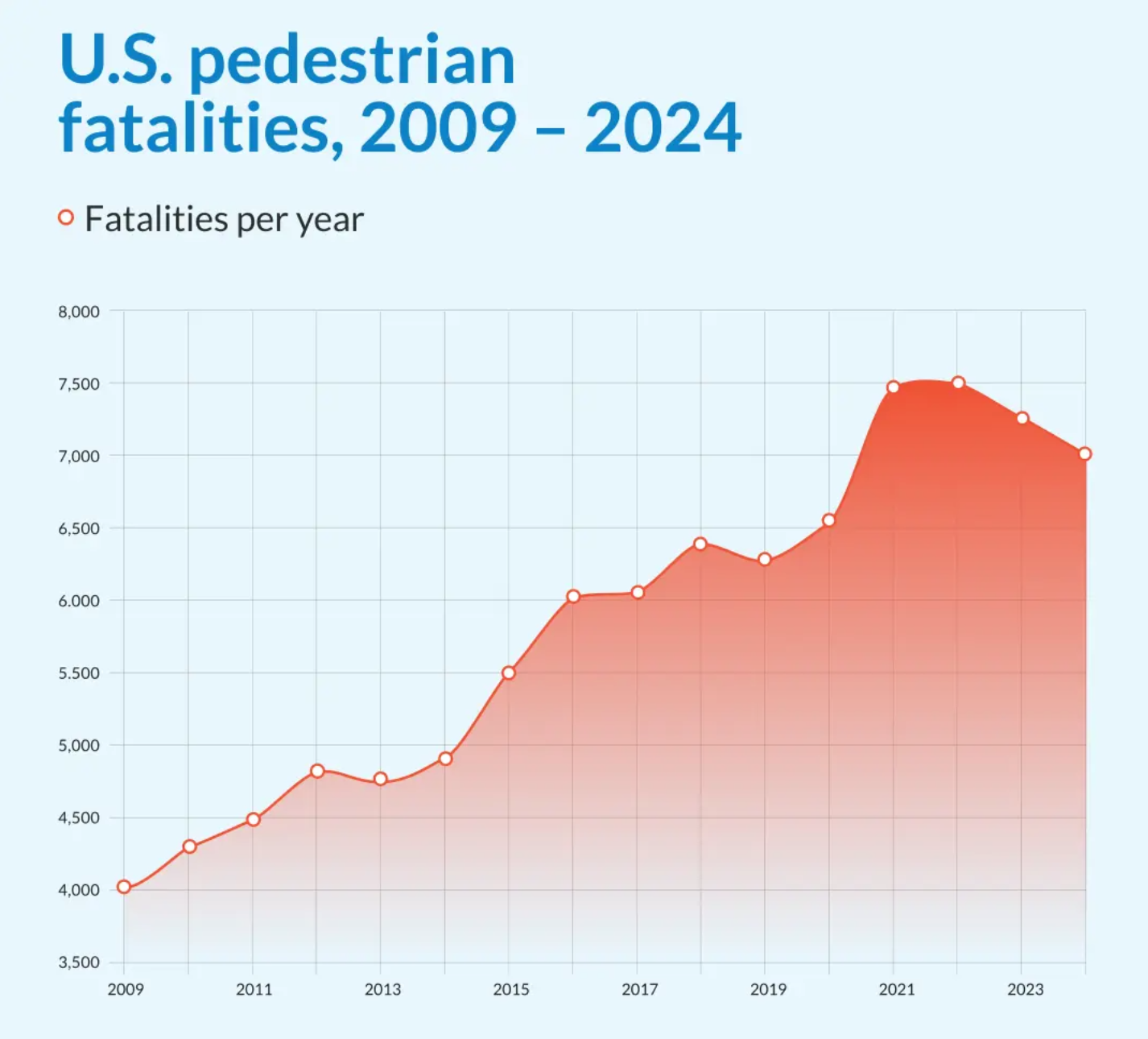

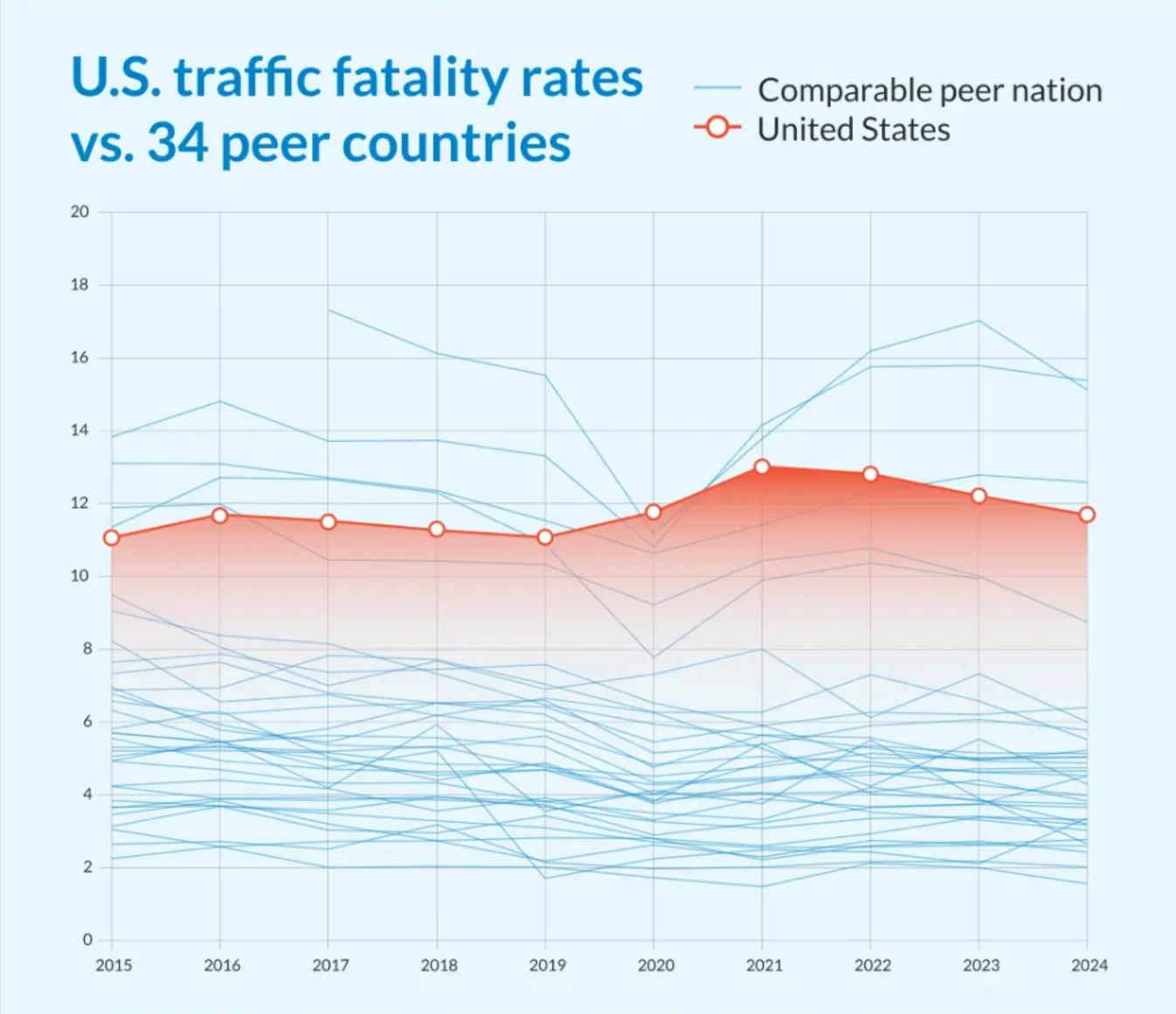
The national organization Smart Growth America has released the 2026 version of their report Dangerous by Design. The report, updated every few years, is the only report of its kind that takes a national view of traffic violence with an eye specifically towards pedestrians and other vulnerable road users.
You can see the full report by clicking here.
This year’s report is a bit different compared to past versions. One big change is the data examined. Smart Growth America compared pedestrian fatalities over two different time periods: 2015-19 and 2020-24. This was meant to not only show a more complete picture of the issue of traffic violence over time, but also to demonstrate that many states and metropolitan areas have actually gotten worse in terms of pedestrian fatalities.
Another change? There’s a greater emphasis on naming decision makers that create a system where traffic violence is the norm rather than the exception. The report goes further than previous editions in naming state DOTs as key actors. That’s because, according to their research, 57% of all roadway fatalities occurred on state-owned roads in 2024.
So, what does the report have to say about Kansas City, and how should state and local decision makers respond to the findings? Let’s dig in and try to answer the big questions:
Where does Kansas City land in the state rankings?
In the ranking of the 100 most dangerous metropolitan areas, Kansas City MO-KS (67th) both ended up on the list. The report shows that both communities have seen growth in the number of traffic fatalities over the time period examined. 184 pedestrian deaths were reported in 2020-2024 as compared to 150 from 2015-2019. That’s an over 20% growth rate. It is important to note, however, that Kansas City’s rate has been lower than the state as a whole.

Tony, Sheila and Paxton, and Travis navigate around a broken driveway approach near Prospect and 14th St in Kansas City, MO.
Where do Missouri and Kansas land in the state rankings?
For the first time in several years, Missouri has the dubious distinction of being one of the most dangerous states in the country for walking. The Show-Me State landed at number 20 on the list for the 2026 version of the report. For reference, the last time Missouri was in the top 20 for this report was 2019 when it was ranked number 17.
Between 2015-19, approximately 500 pedestrians were killed on Missouri’s roads. Unfortunately, that number grew to 637 between 2020-24. This isn’t surprising, considering that Missouri has set and continued to break the record for pedestrian fatalities statewide over the last few years.
Kansas came in at number 36, 3 spots higher than its previous ranking. Between 2015-19, approximately 142 pedestrians were killed, a number that grew to 193 between 2020-24.
What does this look like on the pavement in our region?
Another aspect of the report is showing who is impacted by traffic violence and where those crashes most frequently occur.
In terms of who, the report is clear: in addition to race and income, age is playing a big role in who is most likely to experience traffic violence. As Smart Growth America notes, “People over the age of 65 account for 23 percent of all pedestrian fatalities despite only being 18 percent of the population. This number will continue to grow as we refuse to admit that relying on personal vehicles as the only means of transportation fails everyone, especially older Americans.” This mirrors local trends, as Missouri’s own Long-Range Transportation Plan (LRTP) notes that Missourians aged 65 and older will make up one-fifth of the state population by 2030. The LRTP acknowledges that “the state will need to explore how to best provide mobility options for the needs of those who decide to stop or reduce their driving.” On the opposite end, in Kansas between 2015 and 2024, data from the National Highway Transportation Safety Administration shows that the largest percentage of pedestrian victims were under the age of 5.
Moreover, the location of these deadly crashes echoes what previous reports and local advocates have been saying for some time: Wide lanes, a lack of crosswalks, and long crossing distances create challenges for people walking. Though they use Jackson Avenue and Hollywood Street in Memphis, Tennessee, such descriptions are similar to well-known dangerous corridors across the region. This includes:
- Independence Avenue in KCMO
- Troost Avenue in KCMO
- Central Avenue in KCK
- Lee Boulevard in Leawood, KS

T.J. Roberts of Kinship Cafe shares his vision for public art and pedestrian spaces with Pro-X interns in Kansas City, KS.
How can decision makers meaningfully address these numbers?
While the trends are clear, so too are the actions that Smart Growth America outlines so that decision makers can reverse these trends and save lives. As they put it, “Slightly less deadly is not the same thing as safe.”
Kansas City, and the broader United States as a whole, can make drastic improvements in traffic safety if we do more to emulate the approach that other developed nations around the world have embraced. That doesn’t mean doing the exact same thing as Colombia, Japan, or Sweden. It means picking the parts from these places that work best so that we can create something that fits our local context.
We believe city and state leaders can take the following steps to make streets safer for the next five years:
- Develop a MO Statewide Active Transportation Plan: As we’ve said before, Missouri remains one of only four states in the country that has never developed a statewide active transportation plan. The increase in pedestrian fatalities over recent years shows that the current approach of education campaigns and the Show-Me Zero plan are insufficient to address this growing crisis. We need a plan that explicitly outlines how the state will do more to prioritize the needs of people who walk, roll, bike, and use public transportation.
- Increase Vision Zero funding: In Kansas City, MO Vision Zero funding was reduced by 25% from 2025 to 2026. This is coming at a moment when, nationwide and locally, pedestrians and cyclists are becoming a larger percentage of traffic related injuries and fatalities. For Kansas City KCUR notes that even as traffic fatalities decreased from 2024 to 2025, the percentage that were vulnerable road users (pedestrians and cyclists) was larger than any of the previous five years. The Unified Government of Wyandotte County/KCK, Olathe and Overland Park have all made significant moves since last year by working on the development of new Safe Streets and Vision Zero action plans. This is a step in the right direction that must be capitalized upon with continued adequate funding and community involvement.
- Restore (and increase) funding for public transportation: The Kansas City region is facing potential drastic cuts to our current bus system, one that has already shrunk its reach in cities like Grandview and Independence. Missouri has some of the lowest levels of state funding for public transportation in the region and the country. This not only magnifies challenges for the state’s growing elderly population, but will make life even harder for residents in rural areas who aren’t able to drive. Making an effort to spend more dollars on transit and exploring regional funding models will serve both of these populations and improve safety outcomes along the way.
- Embrace a “Fix-It First” model for future projects: On a more fundamental level, MoDOT, KDOT and their respective legislatures need to move away from a transportation model that continues to emphasize expansion. We already struggle to meet road and bridge repair obligations, let alone trail and pedestrian facility upkeep. Embracing a “Fix-It First” approach (in policy, planning, and practice) is a fiscally responsible way to address safety needs across the state by repairing what needs repair first and using those projects as an opportunity to update facilities to support more modes of transportation.


The Dangerous by Design report paints a sobering and familiar picture about traffic violence in our region. We shouldn’t be silent about what’s happening to our neighbors, and our decision makers shouldn’t hesitate to take steps that we know will work.
As Heidi Simon from Smart Growth America explained, “State departments of transportation are a deciding factor into whether progress is made on a state’s pedestrian fatality rate. The Missouri Department of Transportation controls resources, sets standards, and has jurisdiction to improve the design of some of the state’s most dangerous roads. This should be a wake-up call to work with local partners to implement the changes they know need to happen.”