

E-bike or E-moto?
It has become the talk of the county and our greater metro area that we need to address e-bikes, and regulate for the purposes of safety. However, we must emphasize that e-bikes are not the problem, rather the marketing of e-motos as e-bikes.
Olathe was the most recent city in Johnson County to update its municipal code for e-bikes. The regulations properly define the 3 classes of e-bikes, introduce a helmet requirement for riders under the age of 18, and bundle other electric mobility devices such as scooters and skateboards into a micromobility category separate from the e-bikes.
The updated regulation implies that any electric device that does not fall into the 3 categories is subject to a different set of rules, and is considered an e-moto. There are currently no federal regulations that define and regulate e-motos, leaving the burden to local governments to work out the definitions and the rules. Legislation has been introduced to address this issue, but is yet to be passed into law.
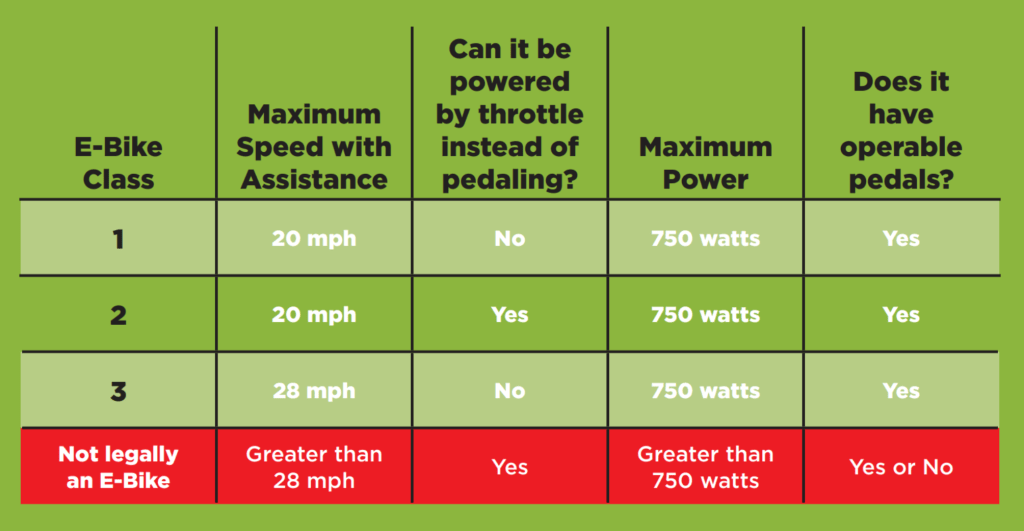
This chart compares the three classes of e-bikes with more powerful and unregulated e-motos. Credit: BikePGH
Until such time, the lack of federal regulation has allowed manufacturers and retailers to falsely advertise e-motos as safe for younger kids, and the attempt to address that by requiring labels on e-bikes may be hard to enforce on the manufacturers themselves. However, it may serve as an impetus for end-users and consumers to be more aware when purchasing their devices.
A patchwork of inconsistent legislation
Another complication with these new rules is the varied legal landscape for different jurisdictions in Johnson County. Each municipality has different rules, highlighted in a new compilation produced by the Mid-America Regional Council, which reviewed codes in the metro area, highlights the need to properly differentiate between e-bikes and e-motos, and encourages educational efforts as the best short-term intervention to improve e-bike safety.
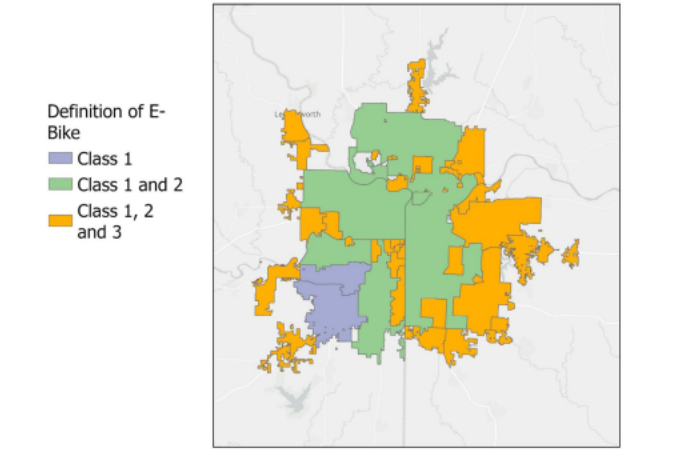
Map of how city codes define electric-assisted bicycles in terms of the three-class system. Credit: MARC
Notably, this figure included in the report shows the difference in how each city code defines electric-assisted bicycles under the 3-class system. A good starting point would be to ensure each city code is updated to ensure all 3 classes of e-bikes are allowed and “protected” on our streets, both from e-motos and regulations blocking their use.
