
New E-Bike and E-Moto Regulations in KCMO: Two Steps Forward, One Step Back
New KCMO law addresses youth on dangerous and illegal e-motos, but also imposes speed limits on adults riding legal e-bikes in KCMO bike lanes.
The Kansas City, Missouri City Council formally approved Ordinance 260508, implementing a new set of regulations for electric mobility devices across the city. It is based on a regional model mobility policy developed through a multi-jurisdictional working group co-led by the Mid-America Regional Council (MARC) and the Johnson County Health Department, with the participation of BikeWalkKC.
The KCMO ordinance is, on balance, a meaningful step forward for safe and consistent e-mobility regulation. However, KCMO city council included two modifications that may undermine progress in ways that deserve serious public attention.
What the Ordinance Gets Right

Properly Classifying Electric Devices
The most important thing this ordinance does is draw clear, meaningful distinctions between different types of electric mobility devices, distinctions that matter enormously for safety, enforcement, and appropriate use of our streets, bike lanes, and trails.
Electric bicycles are defined according to the three existing federal classes:
- Class 1 e-bikes provide pedal-assist only, with motor assistance cutting off at 20 mph.
- Class 2 e-bikes include a throttle and also cut off at 20 mph.
- Class 3 e-bikes provide pedal-assist up to 28 mph, at which point the motor disengages.
Critically, an e-bike is still a bicycle: it has pedals, and the motor only supplements human power. For all three classes, the battery assistance stops at the class’s maximum speed. This is not a technicality. It is the defining feature that makes e-bikes fundamentally different from motorized vehicles.
Electric motorcycles, by contrast, are motorcycles. The ordinance aligns with state law, requiring a minimum age of 16 and a valid driver’s license to operate them. They have no place on sidewalks, bike lanes, or trails, and they should not be marketed to children.

Addressing Misleading Marketing to Youth
The KCMO ordinance also requires retail signage that prevents misleading marketing of electric devices to consumers, particularly parents shopping for their children. This is a practical, targeted provision that addresses a real problem. Many powerful electric devices that are legally motorcycles have been marketed in ways that make them appear to be toys or safe options for kids.
Paired with a framework for educational materials that retailers and schools can use to help parents identify which devices their children should be using safely and legally, this is exactly the kind of policy that protects families without burdening riders.
Creating Regional Consistency
Consistency across jurisdictional lines has been one of the most persistent challenges for cyclists in the Kansas City metro. Riders regularly cross from Missouri into Kansas and back, and a patchwork of conflicting local regulations creates confusion and compliance problems. The adoption of a regional model policy — even with some local modifications — is a meaningful improvement.
Where the Ordinance Falls Short
With the positives on record, we need to be direct about two provisions in the KCMO version that we believe are poorly designed, counterproductive, and in one case, likely to cause real harm.
Problem One: The Mandatory Helmet Requirement
The ordinance includes a mandatory helmet requirement for riders under the age of 18. We understand the impulse. E-bikes are faster than traditional bicycles, younger riders are still developing their judgment on the road, and parents and policymakers naturally want to protect kids. We share that instinct.
But good intentions do not always translate into good policy, and the evidence tells a more complicated story — one where the cure can quietly become worse than the disease.

Helmets Save Lives, Helmet Laws Do Not
Let us be clear: we love helmets. BikeWalkKC distributed more than 450 helmets to children and adults across the Kansas City region in 2025, and we have every intention of continuing that work. The data is clear that helmets reduce the risk of serious head injury, and we encourage every rider to wear one every single time they get on a bike.
But mandatory helmet legislation is a different question. Legislation can be enforced unequally and unfairly in different neighborhoods; there is an access to resources issues, placing burden on vulnerable users, and further promoting inequity. A helmet regulation without a proper helmet distribution program to address inequity will not be sufficient.
Problem Two: The 20 MPH Speed Limit in Bike Lanes
The second concerning provision is the ordinance’s imposition of a 20 mph speed limit on bike lanes and cycle tracks. On its face, this may seem reasonable — but in practice, it creates a serious and unresolved conflict with existing law and undermines the transportation function of our bike infrastructure.

The Problem with Applying Trail Logic to Transportation Infrastructure
Class 3 e-bikes are legally designed to operate at up to 28 mph with motor assistance. They are already legal under Missouri and federal law. Adults who own these bikes have purchased them in compliance with existing regulations and use them to commute, run errands, and travel across the city — often precisely because they can maintain speeds comparable to light motor vehicle traffic.
A 20 mph cap on bike lanes creates a hurdle for legal Class 3 e-bike users, preventing their proper use of infrastructure that was designed and built for them. BikeWalkKC supported the creation of our region’s bike lanes and cycle tracks precisely because they are transportation corridors — not recreational spaces. They exist to move people safely and efficiently from place to place.
We are supportive of 20 mph limits on multi-use trails. Trails serve a genuinely mixed population of users: recreational cyclists, runners, dog walkers, parents with strollers, and children who may dart unpredictably into the path of faster-moving riders. A lower speed limit on trails is appropriate precisely because the context demands it.
Bike lanes are different. They are striped, directional, and separated from pedestrian space. They are part of our street network. Applying trail-logic speed limits to bike lanes conflates two very different types of infrastructure and punishes transportation-mode cyclists for choosing a legal, sustainable, and healthy way to get around.
Where the Real Speed Problem Lives
The speed issue on our streets is not about cyclists going 25 or 28 mph in a bike lane. The speed issue is about motor vehicles.
The League of American Bicyclists’ 2024 resource, “Setting Speed Limits for Health and Safety,” makes the public health case clearly: at 20 mph, a person struck by a vehicle has less than a 10 percent chance of death. At 30 mph — the most common speed limit in urban districts — that risk rises to 25 percent. At 45 mph, the most common speed on roads where cyclists are killed, the fatality risk exceeds 50 percent.
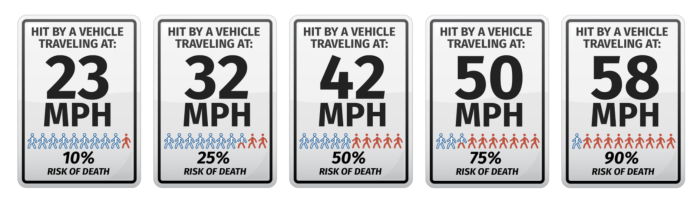
Vehicle size, weight, and speed greatly increase the risk of death for a pedestrian struck by a driver.
Research from London found that streets with 20 mph vehicle speed limits had 21 percent lower injury odds for cyclists compared to streets with 30 mph limits — and that motor vehicle speed was the single most important variable in whether a cyclist suffers serious injury, more significant than weather, time of day, or road geometry.
The research is unambiguous: the danger to cyclists comes overwhelmingly from motor vehicle speed, not from cyclists themselves. A Class 3 e-bike rider traveling at 25 mph in a protected bike lane poses little threat to themselves or others. A motor vehicle traveling at 45 mph on the street beside that bike lane is a genuine public safety hazard.
What Good Speed Policy Actually Looks Like
If KCMO wants to make our streets safer for cyclists, the evidence points clearly in one direction: lower vehicle speeds on our streets through meaningful traffic calming, redesigned intersections, and reduced speed limits — not speed limits on the people we are trying to protect.
NACTO’s Urban Bikeway Design Guide and Safe System Approach both emphasize that the relationship between motor vehicle speed and bike lane design is critical — and that as vehicle speeds increase, the need for physical separation between cyclists and traffic increases accordingly. The solution to high-speed roads is protected infrastructure, not restrictions on cyclists.
Investments that actually reduce cyclist injury include:
- Separated, protected bike lanes with physical barriers from motor vehicle traffic
- Reduced vehicle speed limits on corridors where cyclists and pedestrians are present
- Traffic calming measures such as raised crossings, chicanes, and narrowed travel lanes
- Improved intersection design to reduce conflict points between cyclists and turning vehicles
- Expanded and connected bike network that allows cyclists to choose lower-traffic, lower-speed routes
The World Resources Institute’s research on safe cycling infrastructure reinforces this: cities that invest in physical separation and speed management see the greatest reductions in cyclist injury and death — far more than any restriction placed on cyclists themselves.

The Regional Picture
KCMO’s Ordinance 260508 is one piece of a larger regional puzzle. Multiple jurisdictions on both sides of the state line are still working through the model ordinance process, and the decisions made in Kansas City will influence — and be influenced by — what other cities do.
That is exactly why the two problematic provisions in this ordinance matter beyond KCMO’s borders. If the region coalesces around a model that includes mandatory helmet requirements and restrictive speed limits on cycling infrastructure, we will have embedded those flaws into the policy framework for years to come.
BikeWalkKC will continue to participate actively in the regional workgroup and to advocate for a model policy that is grounded in evidence, equitable in its enforcement, and genuinely supportive of cycling as transportation — not just recreation.